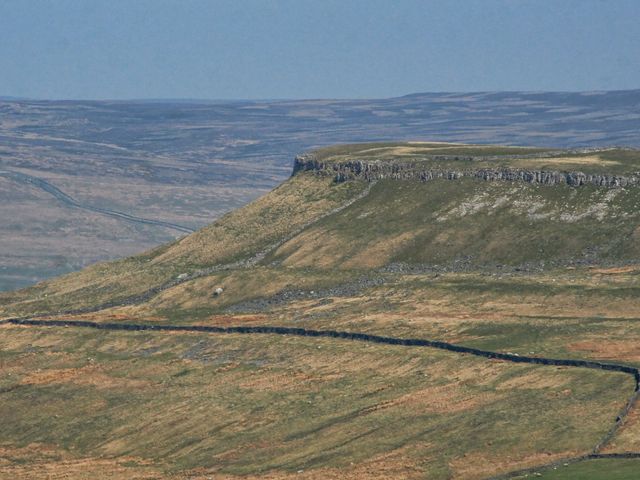
Richmond sits at the bottom of Swaledale, on a rock above the River Swale, with a Norman castle on top and one of the largest cobbled market places in England below it. It’s a proper town, with plenty to do in a day, and it makes a good change of pace from the villages. From Askrigg you can get there down Wensleydale or over the tops through Swaledale, which turns the drive into half the fun.
Richmond Castle
Alan Rufus, of Brittany, started building Richmond Castle from 1071 onwards, a few years after the Norman Conquest, to keep a grip on the north. The great hall, known as Scolland’s Hall, was probably built in the 1080s. It’s been called that since at least 1400, after a long-serving steward of the castle, and English Heritage describes it as one of the most important surviving examples of early medieval domestic architecture in England.
The tall keep, around 100 feet of honey-coloured sandstone, came later, at the end of the 12th century. You can climb it for views over the castle, the town and Swaledale. The castle also tells a more recent story: during the First World War, conscientious objectors were held in the cell block here, and the graffiti they left on the walls is still there. A group of them, known as the Richmond Sixteen, were sentenced to death in France, later commuted to hard labour.
English Heritage looks after the castle. There’s an entry fee for non-members, so check their website for current times and prices.
The Georgian Theatre Royal
Just off the market place is the Georgian Theatre Royal, built in 1788 by the actor-manager Samuel Butler and his wife Tryphosa. It’s Grade I listed and calls itself the most complete working Georgian playhouse in Britain. It also holds the oldest known set of theatrical scenery, the Woodland Scene. It still puts on shows through the year, and runs guided tours during the main season. The seats were built for Georgian backsides, so you’ll feel cosy.
The market place and the Green Howards Museum
The big cobbled market place was once enclosed by the castle’s outer walls. In the middle of it, in the old Trinity Church, is the Green Howards Museum. It tells the 300-year history of the Green Howards regiment over three floors, with the oldest objects dating from 1688 on the top floor. It’s usually open from January to the end of November, closed on Sundays, but check their website for current times.
Richmond Falls and the walk to Easby Abbey
Below the town, Richmond Falls is a series of waterfalls on the Swale, close to the town centre. They’re among the last falls on the river before it heads out into the Vale of Mowbray. Normally they’re a decent size, but after heavy rain they turn brown and loud. Admire them from the bank.
From Richmond, riverside paths through woods and meadows lead to the ruins of Easby Abbey, a house of Premonstratensian canons (the “white canons”). English Heritage puts it at about 1.5 miles on foot from the castle, roughly a 35 minute walk. A popular loop from the market place is about 3.4 miles (5.5 km), around 2 hours, out along one bank and back on the other along the old railway line. The last bit back into town is up steep Cornforth Hill, through a gate in the old town walls, so save some legs. Easby Abbey is free to visit and dogs on leads are welcome.
The Station
Richmond’s old railway station opened in 1846 and closed to passengers in 1969. It was restored and reopened in 2007 as The Station, and it’s now home to a cinema, a cafe bar, a gallery and several local food and drink producers, including a bakery, an ice cream maker and Richmond Brewing. It’s handy for lunch after the Easby walk, and the cinema is useful on a wet afternoon (yes, those happen).
Getting there from Askrigg
- Via Leyburn: Head down the dale to Leyburn, about 12 miles east of Askrigg, then take the A6108 north through Bellerby and Downholme, crossing the Swale just outside Richmond. That’s another 9 miles or so, about 21 miles in total.
- Via Swaledale: Go north over the moor roads into Swaledale, then follow the B6270 down the dale through Reeth to Richmond. It’s slower and twistier, but the scenery makes up for it. Route planners put the quickest route from Askrigg at about 18 miles.
- Time: Some listings say about 30 minutes. On these roads we’d allow 40 minutes or so, and longer over the moors.
- Parking: The market place has some free short-stay parking, with paid car parks a 5 to 10 minute walk away.
- Dogs: Welcome on leads at Easby Abbey. Keep them on a lead in riverside fields with livestock and near the falls.
If the Swaledale route tempts you, stop off at Muker for the meadow walk on the way, and remember to walk single file through the hay meadows.
Go back over the tops at teatime and you’ll have seen two dales in one day.